
Hue Imperial City: The Ultimate 2026 Guide to Vietnam's Forbidden Citadel
1. Introduction to Vietnam’s Most Magnificent Royal Heritage
Resting peacefully on the northern bank of the poetic Perfume River, the Hue Imperial City (Đại Nội Huế) is not merely a colossal architectural marvel; it is the historic heart of the ancient capital and the enduring legacy of the Nguyen Dynasty—the last royal family of Vietnam. With its sprawling complex of palaces, serene temples, and towering gates, it was officially recognized as a UNESCO World Heritage Site in 1993.
The term "Imperial City" generally refers to the two most critical sections of the vast Hue Citadel: the Imperial Enclosure (Hoang Thanh), where the Emperor held court and conducted state affairs, and the Forbidden Purple City (Tu Cam Thanh), which served as the exclusive, highly guarded private residence for the royal family. Spanning over 320,000 square meters, this monumental complex originally housed more than 100 stunning architectural works, all meticulously aligned on a strict symmetrical axis dictated by ancient Eastern feng shui principles.
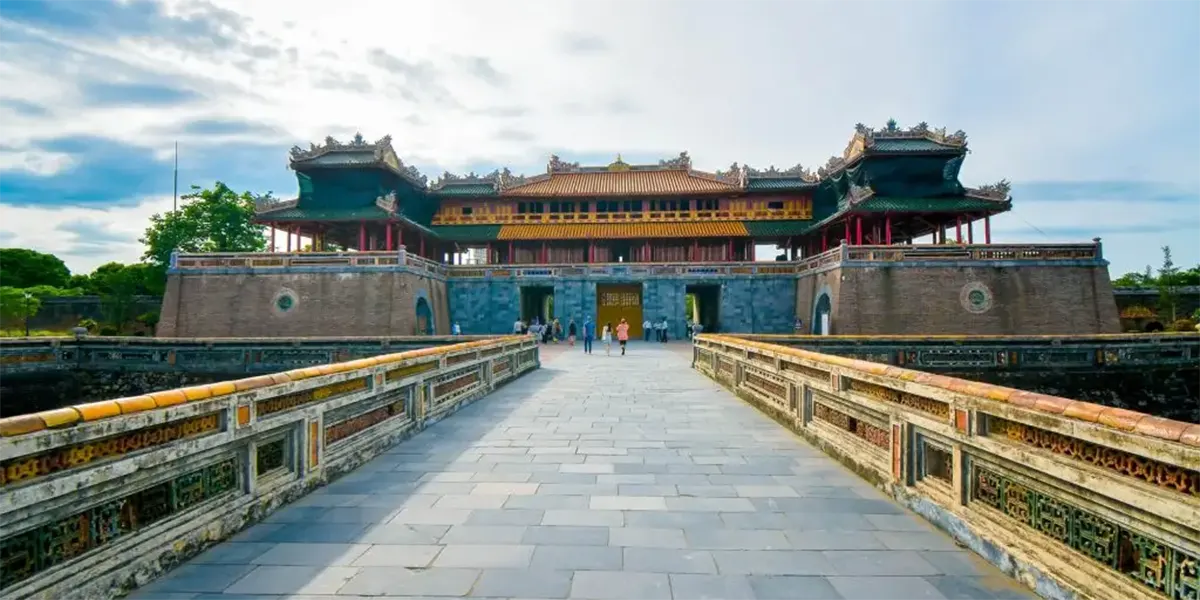
Stepping through the towering Noon Gate (Ngo Mon) is akin to traveling back in time. Despite enduring the ravages of nature and the heavy bombardment of the 20th-century wars—most notably the 1968 Tet Offensive—the ongoing, meticulous restoration efforts have brought much of the Citadel's golden-era glory back to life. Today, it stands as the ultimate spiritual and cultural symbol of Central Vietnam, captivating historians, photographers, and global travelers alike.
• Location: 23/8 Street, Thuan Hoa Ward, Hue City.
• Opening Hours: 07:00 AM – 05:30 PM daily.
• Estimated Visit Time: Expect to spend at least 2 to 3 hours walking to cover the main palaces and ruins. We highly recommend arriving early in the morning to avoid the intense tropical heat and large tour groups.
2. A History Written in Stone: Feng Shui and Warfare
The construction of the Hue Imperial City is a monumental epic of human endeavor. In 1802, after unifying the country, Emperor Gia Long chose Hue as the new capital of the nation. However, it wasn't until 1804 that the massive construction project began. The design is a brilliant, unique fusion of traditional Eastern philosophy (Yin and Yang, Five Elements) and Western military architecture (the Vauban star-fortress style).
Before laying the first brick, royal geomancers (feng shui masters) extensively surveyed the landscape. The entire Citadel faces exactly South—the direction of the Emperor according to the I Ching (Book of Changes). They utilized the natural geography masterfully: the Ngu Binh Mountain serves as a natural "front shield" to ward off evil spirits, while the Perfume River, flanked by two small islands (representing the Azure Dragon and White Tiger), brings prosperity and balance to the royal throne.
3. Highlights of the Imperial Enclosure (Hoang Thanh)
The Imperial Enclosure is the second wall of the citadel, strictly dedicated to grand royal ceremonies and the supreme administration of the country.
3.1. Ngo Mon Gate (The Noon Gate)
Built in 1833 under Emperor Minh Mang, the Ngo Mon Gate is a colossal U-shaped brick and stone fortress that serves as the main entrance. It features five entryways: the central, largest passage with yellow doors was reserved exclusively for the Emperor. Flanking it were gates for civil and military mandarins, and the outermost gates were for soldiers, horses, and elephants.
Perched atop the stone base is the breathtaking Belvedere of the Five Phoenixes (Lau Ngu Phung). This elegant pavilion is constructed from an intricate framework of 100 ironwood columns, assembled entirely using traditional mortise and tenon joints—without a single iron nail. It was here that the Emperor would watch troop inspections and announce the lunar calendar. Historically, it is also where the last Emperor, Bao Dai, abdicated the throne in 1945, handing over the royal seal and sword, officially ending thousands of years of monarchy in Vietnam.
3.2. Thai Hoa Palace (Palace of Supreme Harmony)
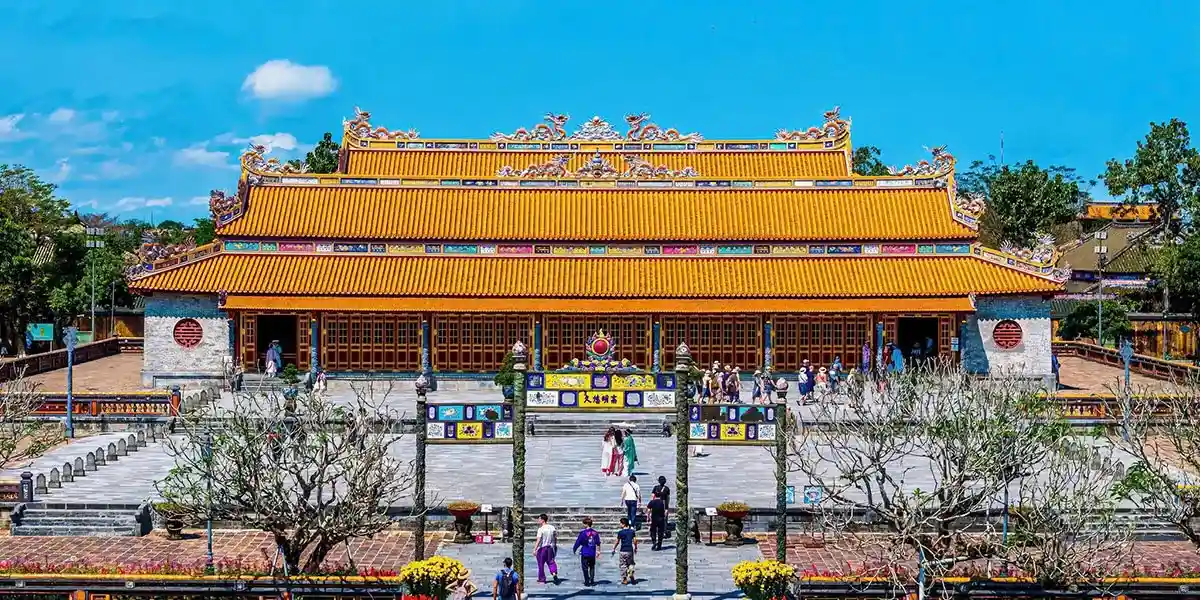
Walking past the Ngo Mon Gate and crossing the serene lotus ponds via the Central Bridge, you arrive at the Great Rites Courtyard and the majestic Thai Hoa Palace. This was the most important building in the entire empire, used for the most critical ceremonies such as coronations and royal birthdays.
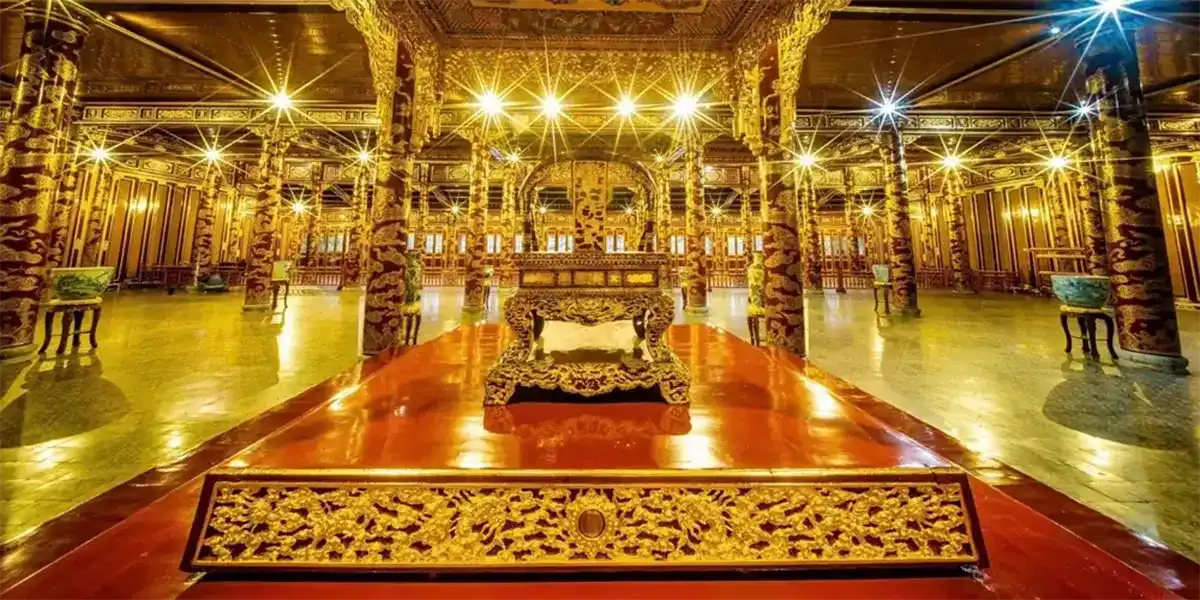
Inside, at the very center beneath an intricately carved wooden canopy, sits the original golden throne of the Nguyen Kings. The architecture is supported by massive timber columns painted with golden dragons soaring through clouds. It represents the absolute pinnacle of Vietnamese royal craftsmanship and the center of the universe according to the dynasty's worldview.
4. The Forbidden Purple City (Tu Cam Thanh)
Located directly behind the Thai Hoa Palace is the Forbidden Purple City. Similar to its counterpart in Beijing, this was the deeply private, highly restricted residence of the Emperor, the Empresses, and the royal concubines. Historically, any unauthorized person found inside these walls faced the penalty of death.
4.1. The Royal Corridors (Truong Lang)
Because the weather in Hue can be notoriously unpredictable—with intense summer sun and heavy monsoon rains—a vast network of beautifully lacquered, roofed corridors was built to connect the various palaces. Today, these newly restored, striking red and gold corridors offer the most photogenic spots in the entire Citadel, allowing visitors to wander through the maze of history under the shade of exquisite wooden architecture.
4.2. Dien Tho Residence (The Queen Mother's Palace)
Located on the western side of the Forbidden City, the Dien Tho Residence is the largest and most intact palace complex remaining today. It served as the living quarters for the Queen Mothers. The atmosphere here is remarkably tranquil, featuring elegant courtyard gardens, bonsai trees, and a stunning lotus pond pavilion where the royal women used to drink tea and recite poetry.
4.3. Duyet Thi Duong (The Royal Theatre)
Built in 1826, this is the oldest functioning theater in Vietnam. In the past, it was exclusively used to entertain the Emperor, the royal family, and foreign ambassadors with classical Tuong (traditional opera) and Nha Nhac (Hue Royal Court Music). Today, visitors can purchase a ticket to watch authentic, UNESCO-recognized Royal Court Music performances live inside this historic venue.
5. 2026 Entrance Ticket Prices
Tickets can be purchased at the main ticket counters right outside the Ngo Mon Gate. Note that while prices are listed below in approximate USD for your convenience, you must pay in Vietnamese Dong (VND) or by credit card at the counter.
| Ticket Type / Route | Adult Price (VND) | Approx. USD |
|---|---|---|
| Single Ticket: Hue Imperial City Only | 200,000 VND | ~$8.00 |
| Combo 3 Sites: Citadel + Minh Mang Tomb + Khai Dinh Tomb | 420,000 VND | ~$17.00 |
| Combo 4 Sites: Citadel + Minh Mang + Tu Duc + Khai Dinh | 530,000 VND | ~$21.50 |
* Note: Children under 7 years old (or under 1.2 meters tall) enter for free. Child tickets (7-12 years) are heavily discounted.
6. Getting from Da Nang to Hue: Private Car Transfer
Hue is located approximately 100km north of Da Nang. To get there, you must cross the spectacular Hai Van Pass or take the tunnel. For foreign travelers, taking a public bus can be time-consuming, and riding a motorbike on the busy highway under the tropical heat can be exhausting and risky.
The most comfortable, flexible, and premium way to explore Hue on a day trip is by booking a Private Car with an English-speaking driver from SafeCarDaNang. Our driver will pick you up from your Da Nang or Hoi An hotel, drive you safely over the scenic Hai Van Pass, wait for you at the Imperial City and Royal Tombs, take you to the best local restaurants for authentic Hue cuisine, and safely return you to your hotel by evening.
| Vehicle Type (Da Nang - Hue Round Trip) | Recommended Passengers | All-Inclusive Rate (USD) |
|---|---|---|
| 4-Seater Sedan (Toyota Vios, Hyundai Accent) | 1 - 3 passengers | $90 USD |
| 7-Seater SUV (Toyota Fortuner, Xpander) | 4 - 6 passengers | $100 USD |
| 16-Seater Minivan (Ford Transit, Hyundai Solati) | 7 - 12 passengers | $120 USD |
7. Crucial Tips for Foreign Visitors
1. Strict Dress Code (Crucial): The Imperial City is a highly revered historical and spiritual site. You will be denied entry to the main palaces (like Thai Hoa Palace) if you are wearing tank tops, sleeveless shirts, crop tops, or shorts/skirts that rest above the knee. Please dress modestly (shoulders and knees covered). Alternatively, you can rent a beautiful traditional Vietnamese "Ao Dai" at shops just outside the Citadel for amazing photos.
2. No Photography Inside Thai Hoa Palace: While you are free to take photos in the courtyards and gardens, taking photos or videos of the Royal Throne inside the Thai Hoa Palace is strictly prohibited to preserve the ancient artifacts.
3. Beat the Heat: The Citadel grounds are massive and offer very little shade in the large courtyards. The heat in Central Vietnam (especially from May to August) can be incredibly intense. Bring a hat, apply sunscreen, wear comfortable walking shoes, and carry plenty of bottled water.
Let SafeCarDaNang handle the logistics while you immerse yourself in the royal history of Vietnam. Book your premium private transfer today for a seamless, unforgettable journey to the Imperial City!
BOOK YOUR HUE DAY TRIP TRANSFER NOW
Travel in modern, air-conditioned comfort. Door-to-door service, zero hidden fees, and absolute flexibility.
RESERVE MY CAR